Monday, September 24, 2007

The 'Clinical' Implication Of General Election

Last few days ago, our hospital has been in the hot seat for most local newspapers. The reason being, the husband of a deceased patient went on to the local politician and started whining his version of story. I had reliable information from my resident officers saying that their family (with the in-laws) had been in a state of discordance. And the act of going on to make a public complain might be a manifestation of that discordance.

To be honest, I don't really know if that's true. But one thing for sure, the local politicians sure gonna love this to the max, much for their own publicity.

Well, that's the typical local political climate. Whenever election is near, the politicians will line up with a hope to appear more often in the headline of newspapers. Sometimes, things might be trivial, nonetheless, they would not hesitate to go to the extra mile for publicity.

I think most of the time, we doctors are in the hot seat of being easily victimised.

After all, doctors only form the minority of the votes. Pathetic?

Wednesday, September 19, 2007

Good Boss, Nice Boss

After some time in the district, I begin to appreciate that being a good boss is no small business. On the other hand though, being a nice boss is relatively easier, and less taxing.

It might be hard to define what's good and what's nice. Let's put things into some common perspective first.

A good boss is one that carries enough qualities that permit him to be efficient to his work and towards managing his subordinates. He might have pissed off some of his subordinates from time to time for the sake of betterment of the system. Overall, he would still be welcomed by most of his subordinates. The support might be variable, nonetheless the system improves.

A nice boss is one that carries enough tolerance to his subordinates that allows him to be championed by them. He might do very little to improve the system but the support that he gains might be tremendous. His subordinates like him a lot because he would say 'Ok' to all their demands.

I think in our country, most bosses tend to adapt to the crowd well. They would become nice bosses eventually. The system, on the other hand, would be static and remain status quo for a long time before an occasional good boss decide to change.

Any good bosses up for the job?!

Saturday, June 23, 2007

'Nothing To Lose' Mentality

Back in a couple of days ago, my senior MA told me of an interesting and yet distressing event in our clinic.

A patient suddenly ran amok and got into an heated argument with my MA and nearly punched him in his face. When asked what was the precipitating events, rumours said that it was due to a misunderstanding of appointment time given. The patient wanted to be seen right away. It wouldn't happen, and hence the cascading mishaps.

Another contrasting incidence happened quite some time ago in my in-laws house. My sister-in-law had just come back from her follow-up visit to a gynaecologist from a local private hospital. She was in the state of very remarkable anger. When asked what was the problems, she told me that the doctor was extremely rude to her. Rumours said that it was due to the fact that my sister-in-law had misplaced some tablets that were prescribed, and she wasn't following exactly the prescription. The gynaecologist had scolded her right in her face.

"Well, you could have just complained to the hospital admin, if you think he's rude. That's your right. You're in a private facility. Customer's satisfaction is their prime concern, for business." I suggested this, intending to calm her down.

She thought for a moment.

"No, it's no good making an official complaint."

"Why is it so?" I was rather amused by what she said, frankly.

"I waited so long and I've paid so much to see him. I can't just complain. It's not worth it. You'd never know whether he would change the treatment... or something like that. As long as the medicine is still working, it's ok."

As much as I can gather, most probably she didn't even dare to wink her eyebrows too excessively in front of that private gynaecologist. Let alone to mention about punching someone in the face;)

Ladies and gentleman, boys and girls, as you can clearly see from these 2 extreme examples that I managed to recollect, the contrasting facts are just quite self-explanatory!

The first case was a patient who paid around 5 bucks to see a specialist. He was angry because of a long waiting time, and he ran amok without much hesitation.

The second case was a patient who paid around 200 bucks to see a specialist. She was angry too because of a long waiting time plus the fact that she was scolded for poor compliance. Nonetheless, she was careful not to show too much of her anger in front of the doctor. And definitely no running amok kind of behaviour!

In the first case, there is this deeply embedded 'nothing to lose' mentality. Probably what he thought was that he had nothing else to lose except the 5 bucks. He walked out of the clinic in giant steps and style.

In the second case, 200 bucks is "everything to lose", for most people.

It's rather sad to conclude this way. Amidst the striving effort of government health care staffs to provide free or near-free service, the signs of appreciation from the crowd are still generally lacking. There are some who would show appreciation, but most would take it for granted.

Suffice to say, cultivating and nurturing the 'nothing to lose' mentality amongst them is not a good strategy in a long run.

One must have something to lose, else he has nothing to protect, not even his own integrity.

Saturday, June 16, 2007

5-star Downgrades To No-star!

I stayed over the weekend for a wedding function in one of the supposedly 5-star hotels in the capital.

What initially thought to be a pleasant stay soon turned out to be a mess. Firstly, upon checking in, I found that there's no towel provided in the room. I called for an urgent supply. That's not the 'best' part, I later came to know that my 'debris' could not be flushed away in the toilet. I flushed repeatedly but it seemed that the pipe system had been engaging a bit of strike against the hotel. I called again for a fix, also reminding them about my towels.

I waited for an hour. I finally decided to go out to get things done by myself. I met with one of the service boys in the elevator and managed to get a towel. Lucky me.

I called for the third time regarding my complaints, stressing on the 'floating' debris that was more distressing than any other things. They didn't come, not until the late midnight. They apologised, saying that the whole hotel was fully housed with guests and they just couldn't cope with the demands. I said I understand.

A 5-star hotel gets downgraded (at least, in terms of rapidity of service) to a lesser grade.

Not that the hotel management did it on purpose.

Nor did the guests actually purposely overloaded them with demands.

It's just the way of the service industry works.

As the number of guests/ customers increases, the ability of the system to cope with the demands would largely depend on its available resources.

The same principle applies for medical health service as well.

It's even more staggering true in the context of public health service in this country.

Near-zero charges and an ever mounting number of patients.

The public needs to learn the necessity and the art of 'waiting', for a free service, run by just a handful of sorely underpaid staffs, under a system which is imperfect in many ways.


Sunday, May 27, 2007

Build A District Empire, I Must


Yet another interesting gesture by some of my district colleagues.

My soft-spoken SHO, Dr AR, has complained to me recently about an incidence that involved her and one of the relatively more senior SHO from another department.

My SHO was tearful after being 'reprimanded' heavily by the so-called senior colleague.

The details of the incidence was not known to me, as my SHO was reluctant to carry the agony of going through the details once more. But I gathered that she must have been 'made' to given in to the incidence after being taken under heavy fire for some time. She wanted to make the incidence as 'personal' and 'off the record'. As per her soft-spoken character, I respected her decision.

If not, by virtue of my usual character, I would have summoned the 'senior' SHO for a mutual discussion.

As I was continuing my round with another SHO of mine, she told me that it was definitely not the first time that the 'senior' SHO in regard had acted this way.

"If you think she's been unreasonable, why not fight back?" I asked.

"She's more senior and her bosses cover her very well. Their department is stronger."

I was pretty much amused and subtly surprised by her comments.

I had to admit that though. My department has been a place with rapid shuffling of manpower and staffs, especially of the higher ranking ones, such as the head of department. The SHO pool was rather stable in a sense. This is partly owing to the fact that most physicians posted to the district will tend not to stay too long. They would stay for a year or so, and then got transferred away for subspecialty training.

On the other hand, there are 'hardcore' specialists in other departments who would stay in the same hospital for a long long time, thus cultivating and nurturing their own 'district empire'. Not only then, their SHOs would tend to follow suit, thus rendering an environment which is 'not intentionally' hostile, but 'much potentially' condescending for the lesser ones.

Having said so, the culprits are made up of merely a handful of them. Nevertheless, a handful is sorely more than enough.

Tuesday, May 22, 2007

No! You Can't Follow-up Your Old Patients!


I am not sure since when this phenomenon has prevailed. I picked up this comment while I was sitting in a combined clinic (obstetrics and general medical clinic) in my hospital.

After becoming a physician, I was posted to a district hospital pretty much near the vicinity where I live. Considering myself lucky, I accepted the 'offer' quite happily.

It has always been my style that I'd like to review patients that I've seen earlier on, so that I can keep track of their clinical response to treatment and intervention. I have been doing this alright with no problem at all..until I met with this old lady obstetrician in my district hospital.

It was a fine day. I walked into the consultation room. Happily browsing through the folders that laid in front of me, I asked one of the nurses: "How many patients are there for us today?"

"Why?!" The old obstetrician raised her voice, even before the nurse managed to throw in an answer. For a moment, I thought she was not yelling at me. I ignored.

"Hey, why?!" She blurted again, much in a stiffer tone of voice. I had already start noticing some gestures from the nurse.

"Oh, I would like to know the progress of the patients that I've seen during the last visit."

"No, it is IMPOSSIBLE!" She dragged the word "impossible" as though as I would not understand the word if she hadn't done so.

I walked away, went into another room sitting with another obstetrician and start seeing patients. I asked the nurse in the room for a favour: "Could you please walk to the next room and look for the cases that I've jotted down 'to see me on TCA' and bring them to this room?"

The nurse went. Minutes later, she walked back with 2 folders.

I went according to the queue number and saw the 2 patients in turn.

I had a short discussion with the O&G head of department later regarding the incidence. He was more approachable and agreed on my move to review previously seen patients.

There are 2 points to highlight in this particular incidence:
  1. Following-up patients with regards to their management and outcome is just like doing a small 'cohort study' whithin yourself. It not only benefits the patients, but also the clinician himself as it invariably sharpen their clinical acuity over time.
  2. 'Chronic' specialists residing in the districts can become complacent with time as their decisions tend to become 'unquestionable' by more junior colleagues. This cultivates a sense of false superiority in them. I call it the pseudo-superiority complex, as it collapses easily upon careful scrutiny by more experienced consultants from tertiary centres. I hope, one day, she will be scrutinised.

Sunday, May 06, 2007

"Wifi"able My Clinic Area


Today, I made some improvements to the 'techie' aspect of my hospital clinic. I installed a wireless router onto the medical outpatient clinic.

Finally, I can get my hands on the internet for any information needed, in realtime that is ;)

Hopefully, that should also fix my relatively 'not-so-often' blog posts. Hehe.

Sunday, April 29, 2007

I Want My Warranty!


Recently, a patient with a history of MI saw me during a stress test visit. He completed stage III without any complication. I told him that he had made an excellent recovery nonetheless keeping in mind of life-long adherence to medications and life style modification. I extended to him that a coronary angiography might be an option if he becomes symptomatic and interventions of either surgical or percutaneous route would be needed.

I routinely explained to him regarding the small but significant risks of on-table MI, stroke and death during angiography. He backed off after my explanation. It was as expected. I reassured him that medical therapy is as good as invasive interventions in face of asymptomatic status. He accepted and left my clinic happily.

I thought I have managed to convince a patient, but then..

10 mins later, a man busted into my room. Claiming to be one of his cousins, he demanded me to explain to him again from scratch. He told me that he knew Dr Z and Dr B (2 consultants in the hospital) well, and they always went out for drinks together.

Fortunately, I didn't have any more patients left and hence patiently I re-explained everything to him, in the presence of that patient. I reinstated the need of intervention in the future if he becomes symptomatic and the risks involved. I also told him that I have already made an informed decision with the patient.

"How do you be sure that he's ok if you don't do an angiogram on him?"
"I want an angiogram to be done on him."
"You know, if anything happens to him, YOU ARE responsible you know!"

I practically felt like being threatened and/or blackmailed by him!

In my clinical experience, I find that sometimes patients or patient's relative demand 'warranty' after a course of treatment. Well, the fundamental problem is that, THERE IS ABSOLUTELY IMPOSSIBLE TO HAVE WARRANTY IN CLINICAL TREATMENT!

Really, off-hand I can't recall any clinicians that have ever given out a 'warranty' to patients before. Enlighten me if I'm wrong ;)

That cousin of him really served well in 'sabotaging' the good doctor-patient relationship that I've strived to establish. Maybe one day, he could finally understand this when he's out drinking with either Dr B or Dr Z?

On second thought, maybe not...

Sunday, January 21, 2007

I Say Oyster...


This post is specially dedicated to my dear comrades in my hospital who strive so hard in the path of becoming an MRCPian.

They are all taking the February diet in UK. I wish them all the very best!

Traveling in UK is a bliss. I'd had no problem at all in moving around the metropolitan. I don't work for TfL but I must say that their oyster card concept has been a great advantage for budget travellers like me.

You have the options of buying a flat-rate card for 1/52 travel or pay as you go etc.

Remember, my dear friends, YOU ARE JUST ONE STEP AWAY FROM BECOMING AN MRCPIAN!


Monday, October 30, 2006

A Whole New Experience In UK Hospital


I'm privileged to have the opportunity to be a clinical observer in one of the local hospitals prior to my exam.

I must say it was an eye-opener as one could really appreciate things differently.

People here tend to express themselves more openly. I must say I like that very much in fact ;)

Will share more experience upon touching ground back in my 'waterland'.

Cheers mate ;P

Saturday, September 30, 2006

Encore! Another Round?


Of late, I had an interesting conversation with one of my senior colleagues in another department.

We were discussing about the number of ward rounds per day that should be fulfilled. In my department, we only had 1 official round per day. Altogether bosses, SHO's and HO's would do round together and settle clinical issues as they arise. Of course, unstable patients will be kept in mind for more reviews in the late morning or afternoon, keeping in view of passing over to the on-call team for review after office hours.

My senior colleague had proudly told me that in his department, there is no such thing as daily round. Ward rounds are carried out in a tds (3 times a day) or at least bd (2 times a day) basis, and that is compulsory!

He suggested to me that maybe my department should follow their 'noble' path as well.

;)

Ward rounds are designed to pick up clinical problems, so that appropriate clinical action can be taken. Imho, ward rounds should NOT be routine or compulsory, as there are no such thing as 'routine' clinical problems in all patients. Unstable patients should be given more attention and hence more reviews (I won't even call it a ward round!). On the other hand, doing a routine round on a stable patient would be mean a wastage of manpower and resources, which could be channeled elsewhere more needful.

I end my blog by giving you my own experience when I was a paediatric HO.

In the morning, I was following the ward round.
HO:'Day 3 of life, admitted for NNJ, now on single phototherapy...'
While examining the child, the specialist murmured:'Active, not tachypnoiec, jaundiced. CVS no murmur. Lungs clear. Per abdomen, soft non-tender, liver palpable 1cm. Moro's complete. OK, continue the single photo.'

At noon, the same baby was reviewed.
HO:'Day 3 of life, admitted for NNJ, on single phototherapy...'
The same specialist:'Active, not tachypnoiec, jaundiced. CVS no murmur. Lungs clear. Per abdomen, soft non-tender, liver palpable 2cm. OK, continue the single photo.'

Right before going home late in the evening, another round.
HO:'Day 3 of life, admitted for NNJ, on single phototherapy...'
Again, the same specialist:'Active, not tachypnoiec, jaundiced. CVS no murmur. Lungs clear. Per abdomen, soft non-tender, liver palpable 1cm.'

As you can see, the only changes were that of the liver size, which grew to 2cm and shrunk back to 1cm in the same day!

Wednesday, September 06, 2006

Switched Folders, I Have


Shortly following my blog on the public health equation, I am privileged to have picked up yet another interesting gesture by some patients.

My patients just hate waiting. Well I guess most human being dislike waiting, in particular, waiting for no reason. Nonetheless, I think waiting in a queue to be seen by a non-stop performing doctor is a justified act... suffice to say.

It was a fine morning clinic session. I was seeing a long queue of patients. Some were stable enough to be seen quite fast. Some would need more meticulous consultation and hence more time spent. There was this 68-year-old uncle, who was an ex-teacher, came for follow-up for his chronic stable angina.

I had just finished seeing the 32th patient. Owing to the lack of manpower, the folders were arranged in a row near the entrance to my room, and I'd have to walk in front to pick up the next folder and call the corresponding patient by myself. I had noticed some peculiar stigmata when I saw that this 68-year-old uncle had switched his 36th folder to the top, covering the 33rd.

Honestly, I wasn't happy at all. I then told him:" I'm sorry uncle, it's not your turn yet".

He quickly retorted me:" You know how long have I been waiting? I'm an old man. I can't stand waiting for too long!"

I said:" I understand that you've been waiting. But the queue is moving. I'm afraid you'd just need to wait for your turn." I added:"Most of my patients here with heart illness are elderlies anyway!"

He retorted further:" You don't talk to me like this young man. I was a faithful government servant that served this country before you were even born! I deserve to be treated nicely! You are very rude you know young man"

Somehow my conscience told me that any further arguments would not be fruitful anyway. To me, we were seeing things in 2 extreme perspectives.

I quickly glanced through the 33rd patient's folder who I should be seeing in queue. I was instantly struck by an inspiration...;)

I called the 33rd patient by name and summoned her into my room.

She was a 82-year-old lady with history of multiple embolic stroke being followed up for chronic persistent AF with anticoagulation. Her daughter was wheeling her in on a wheelchair!

I told her that this 68-year-old senior gentleman was trying to jump into her queue, because he couldn't stand waiting anymore.

She became agitated and almost cried:" I was waiting for a long time also. Doctor, can you please see me first?"

That 36th uncle, red-faced, walked away. He didn't say a word, not even a word of apology.

Wednesday, August 30, 2006

Our Public Health Equation


Q=Quality/speed of service
MD=Staffs available, in this context, MD
t=Time available
P=Patient load

Well, let's do some maths then.

I was recently approached by a patient who relentlessly complained to me about his unacceptably lengthy waiting time. Our follow-up clinic has always been fully booked and occupied, partly owing to the fact that we are the only cardiac referral centre in the whole region.

Mr F's waiting time was, effectively, 48mins, running a bit short of an hour.

He was the 69th patient in the queue. The total number of patient for the day was 127, and the total number of doctors in the clinic was 8. Let's say one patient takes 15mins, it'd require approximately 2 hours to reach Mr F by right.

I'd said: "Guess we're seeing you too soon."

Our clients (the public) usually cannot appreciate this simple equation of relationship between capability of the system and demand on the system.

You'd need an upgrade on your processor and peripherals (of manpower and resources) if you don't want to wait for your Windows to load a program for too long.

Well, another option is to overclock the system. Be wary though, your motherboard would probably die faster and your processor would suffer premature failure and finally refuse to work if you push it too hard!

Sunday, June 25, 2006

Happy Birthday To eMRCPian!


I devote this special blog to my dear friend emrcpian. Happy birthday!

Now you're older by a year ;P

Something About Referrals


In my recent calls, I received numerous referrals from my colleagues, of which some were pretty much out of expectation. Of most interest was a referral by my former senior cardiology colleague.

He asked me to review a middle-aged lady who had multiple myeloma and complained of atypical chest pain which was pricking in nature. Her ECG had shown 0.5mm T inversions from V1 to V4. He told me that he was sure that it was nothing of cardiac in origin. Nonetheless he still would want me to see. Just to cover his track as he said.

I saw instantly and repeated an ECG which showed T inversions from V1 to V3 of the same morphology. I proceeded to demonstrate to the ward nurses the way to 'reproduce' the inverted T in V4. I placed the V4 lead closer to the sternal border and wahlah! ..T wave was inverted again in V4. I wrote down my assessment and offered my opinion that it was non-cardiac atypical chest pain.

Well, don't get me wrong. I'm in no way against any referrals from my colleagues. It's the professional codes that dictate every doctor to see referrals and to offer assistance to the very best interests of patients. Nevertheless, referrals must be indicated, and if possible, be optimised, so that limited resources and manpower could be channelled to the necessary individuals and patients. We live in a world with scarce and limited resources. This, unfortunately, we can't change.

If my former senior cardiology colleague was sure about the diagnosis, why refer? This is something for everyone of us to ponder about.

What'd be your say?

Saturday, June 24, 2006

Back In Action After A Long Break!


Aha.. I'm back in blogging business after a break for my peri-exam period. On the whole, I can only say that the exam was surely tough. In fact, it's tougher than anyone (who hasn't gone through it yet) can imagine!

Thought of starting another blog on my social life but so far need to gather up some extra time for that :)

I'd already done 4 calls after coming back from my exam. Interesting things ahead to share with all! Stay tuned :D

Thursday, May 18, 2006

Chorus That I Need To Sing;P

MRCP- It teaches more than it tests


This is the quote that I find most inspiring and it really holds true as you venture along the path of being a 'mrcpian'.

Singing the 'songs' after the end of each examination would better be termed singing the 'choruses', as each of these would invariably be repeated for tonnes of times before one would sit for the exam:)

I would like to complete my examination by...


1) CVS: AR
BP for wide pulse pressure
Peripheral signs for AR
Signs of IE if suspected

2) CVS: AS
BP for low systolic/narrow pulse pressure
Signs of IE if suspected

3) CVS: TR (functional or structural)
(Of course, you'd have found a PSM at lower LSE best heard at inspiration along with a promivent v wave to say this:)
Examine the abd, in particular, to look for a pulsatile liver

4) CVS: Severe MS +/- pulm HT
BP
Signs of IE if suspected
Examine the lungs to look for bronchial breathing at left middle zone (collapsed consolidation of left middle lobe d/t enlarged left atrium compressing on the left brochus)
Talk to patient to look for Ortner's syndrome (hoarseness of voice secondary to left recurrent laryngeal nerve palsy from left atrium enlargement)

5) CVS: prosthetic valve(s)
Midline sternotomy scar is present...there is a metallic click which coincides with the 1st HS best heard over the mitral area...and there is no evidence to suggest leakage of valve...and clinically there is no evidence to suggest overwarfarinisation.

6) Abd: CLD
Scrotum for testicular atrophy
PR to look for malaenic stool (if pallor present)
...there are signs to suggest CLD as evidenced by the presence of... Therefore, I think this pt has CLD, but there is no sign to suggest that he is in hepatic encephalopathy. The possible etiologies I'd like to consider are...

7) Abd: APKD
Examine the BP to look for hypertension.
Dipstick the urine to look for proteinuria & haematuria
Examine the CVS in particular to look for MVP.
...previous peritoneal dialysis scar noted at the infraumbilical region... I think this patient has adult polycystic kidney disease in ESRF requiring haemodialysis. No signs of fluid overload. No signs to suggest that this patient is in uraemic encephalopathy.

8) Abd: Hepatosplenomegaly d/t myeloproliferative disease
Examine all the lymph nodes to look for generalised lymphodenopathy

9) Respiratory: Pleural effusion
Examine the sputum macroscopically, in particular, looking for haemoptysis
Dipstick the urine for evidence of gross proteinuria
....the etiologies I would like to consider are mitotic lesion of the lungs as evidenced by finger clubbing, cachexia and heavy nicotine stains; mycobacterium infection of the lungs and the remote possibility of a parapneumonic effusion of the lungs.

10) Respiratory: AECOAD
Examine the sputum mug to look at the sputum macroscopically, and to do a bedside PEFR for the pt.

11) Respiratory: Bronchiectasis
Examine the sputum mug to look for foul smelly copious sputum and haemoptysis
CVS- dextrocardia (if suspected Kartegener synd); loud P2 with left parasternal heave to suggest pulm HT

12) Respiratory: Dullness/consolidation apex
Examine for wasting of the 1st dorsal interossei of the ipsilateral hand, and to look hard for ipsilateral Horner's synd.

13) Neuro: Parkinson disease
Examine the standing and lying BP, examine for coordination to look for cerebellar signs and to check patient's upward gaze. I also would like to look for any evidence of long tract signs by carrying out a full upper limbs and lower limbs neurological examination.

14) Neuro: Unilateral facial nerve palsy
Examine for cerebellar signs, checking patient's ant 2/3 of the tongue for taste & sensation. Further examine the 8th CN by doing Rinne & Weber's test and to do a full otoscopic examination.

15) Fundus: DR with maculopathy
Examine pt's visual acuity (& to plan for an urgent ophthalmology referral; esp when there is significant VA impairment)

MRCP; Membership of Royal College of Physician- They only give that to the crowned heads of the world:)

Friday, May 12, 2006

Homage To Traube;)

My dear friend emrcpian had recently posted a blog on abdominal examination and had mentioned about the use of 'traube's space'.

It remains as elusive as it was back in my student years whereby conflicting opinions prevail till these days.

I had done some 'click and research' via the net. Would like to share :)

About Ludwig Traube, the original guru who described the Traube's space:
"Great merits and fame earned Ludwig Traube by establishing of the experimental pathophysiological research in Germany (e.g. he did animal experiments in the 1840th in his Berlin flat in the Oranienburger Str.) He improved the physical-medical methods like auscultation and percussion and was a taxonomist of the medical documentation. (e.g. inaugural of the temperature-pulse-frequenz of respiration-curve into clinical praxis). He investigated the pathophysiology of the respiration and the regulation of the body temperature, and gave a scientific basis to the digitalis therapy. The narrow coherencies between heart and kidney diseases have been well demonstrated. He worked together with Rudolf Virchow (1821-1902), they substantiated the „Beiträge zur experimentellen Pathologie“."

Wikipedia:
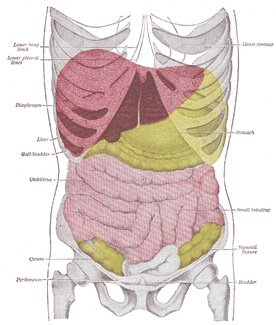
"Traube's (semilunar) space is an anatomic region of some clinical importance. It's a crescent-shaped space, encompassed by the lower edge of the left lung, the anterior border of the spleen, the left costal margin and the inferior margin of the left lobe of the liver. Thus, its surface markings are respectively the left sixth rib, the left anterior axillary line, and the left costal margin. Underneath lies the stomach, which produces a tympanic sound on percussion (medicine). If percussion over Traube's space produces a dull tone, this indicates splenomegaly. Assessing this may be more difficult in obese patients. The normal human spleen measures about 125mm in length, and splenomegaly is an important clinical sign. There are 2 possibilities to evaluate splenomegaly in the clinical examination: percussion and palpation. Percussion can be done in Traube's space, as described by his pupil in 1868. Another method was described by Donald O. Castell in 1967 (Castell's sign)."

Conclusion:
I think the percussion of Traube's space is both a non-sensitive and non-specific way of assessing for splenomegaly. As you can see, anatomically, it's bounded by the lower left lung, anterior border of the spleen and the left lobe of the liver. Hence theoretically, any enlargement/effusion of these structures could obliterate the space and hence would cause 'dullness' upon percussion.

As alluded earlier in Ludwig's biography, one of his main interests was in respiratory medicine. Hence it's not surprising that he had originally ascribed the dullness to pleural effusion instead :)

"Look out for the original papers decades back describing the eponymous syndromes or signs, and you'll be surprised how much they have evolved/changed through the years." -My neurology clinical mentor

Sunday, May 07, 2006

A Little Untoward Event


An interesting event happened couple of days ago.

One colleague of mine paged me on my on call day, seeking for opinion on the management of a patient with unstable angina who had developed one episode of transient bleeding while he was on LMWH. From what I’d gathered over the phone it occurred to me that the patient was rather stable with minimal chest pain. I suggested him to switch to conventional unfractionated heparin instead, with careful monitoring, keeping in view of potential rebleeding. He thought the half-life of UFH was 6 hours. I corrected him by telling him that it was only 90mins (hence easier reversal and less prolonged bleeding should the patient bled again). Probably, this was what tickled him off ;P

I have always wanted to know (and get acquainted to) as many as possible of my medical colleagues elsewhere in the vicinity. Basically it’s for the sake of easier understanding among one another, as well as mutual sharing of clinical experience and knowledge.

As a friendly gesture, I had enquired him regarding the year of graduation and the university that he had graduated from, for I wanted to quote some names of my close friends of his batch. (We lead a rather small community in the medical line in our country, and eventually we tend to meet back one another rather soon!)

I was totally taken by aback when he accused me of being arrogant and that I had tried to insult him by asking his year of graduation. I eventually ended up half-apologising-half-pacifying him over the phone. Tough job indeed!

From this little untoward incidence, I could gather a few points of thoughts:
  • Asking the year of graduation (and hence implies his seniority) would not be a good idea after a ‘skewed’ consultation. The other party would think that you’re trying to patronize him
  • Over-the-phone consultation is both not specific and not sensitive (at least, the other party wouldn’t be able to pick up some visual cues that could have saved the misunderstanding)
  • The referred party needs to be extremely cautious, as the referring party is easily sensitized by some unintentional audio cues, which is strongly influenced by the often imbalanced senior-junior relationship and is relentlessly driven by a hidden sense of inferiority complex among the juniors. Things could be quite different, if he were the senior :)

Sunday, April 30, 2006

Sorry, 'Cinderella Effect' Not Available Here

As I have repeatedly alluded to my house officers before, becoming a competent and reasonably knowledgeable doctor is a tough ticket to get, at least not without going through a rather eventful learning curve. There's definitely no such thing as 'Cinderella effect', whereby one can become a super consultant overnight by wearing a pair of magic glass slippers!

Of late, I had a disagreement with my ward nurses over the issue of 'informing house officers first' versus 'bypassing the house officers and informing SHO straightaway'.

Basically I have no objection on the notion of informing SHOs in the first place if the urgency of decision on management is going to alter the course of clinical outcome. One good example would be a collapsed patient needing acute medical attention. Any doctors at hands should rush to the scene to resuscitate the patient. The SHO, being more experienced than his junior counterpart, would be of role in carrying out important decision making. Making him available would thus be a wise choice.

On the other hand, house officers should not be deprived of any chance in attaining clinical experience just because they are less experienced!

As recalled from my conversation with my ward nurses, one of them had shamelessly said so:" Aiyo doctor, housemen cannot make decision one. So why not call you straightaway. Later call the houseman, he also need to call you..." I said:"OK, I'm here now, please call the house officer along." She answered:"You're here already, no need to call him. Let him rest."

I couldn't have disagreed (and been disgusted) more.

Luckily, only one particular ward nurses behaved in such a way, other wards are still manageable. Well, I did think it over and try to put myself in their shoes. I think it's really tempting to 'settle' things as soon as possible. After all, they'll probably need to pick up the phone the second time (to call me) if the house officer can't come up to a solution. Extra work always means 'no good' to them :(

Nonetheless, on the whole, I think it's critically unfair to the house officers if they are ousted just because they are less experienced, and hence denied of any potential opportunity of decision-making.